Quick answer
What this means in practice
Mortgage default insurance protects the lender if a borrower defaults. It does not replace disability, life, job-loss, or payment-protection insurance for the homeowner.
Key takeaways
- Mortgage default insurance protects the lender, not the borrower.
- Homes priced at $1.5 million or more require at least 20% down and are not eligible for standard high-ratio mortgage insurance.
- Premiums depend on loan-to-value and program details and may usually be added to the mortgage.
- Ontario sales tax on the insurance premium is normally due at closing and cannot be added to the mortgage.
It commonly allows an eligible owner-occupied purchase below $1.5 million to proceed with less than 20% down. The lender submits the application to an approved insurer and remains responsible for approving the mortgage.
When mortgage default insurance is required
A purchase with less than 20% down will typically require mortgage loan insurance, subject to the property, borrower, price, and insurer program meeting the applicable rules. For homes priced below $1.5 million, the minimum down payment is 5% of the first $500,000 plus 10% of the portion above $500,000. Homes priced at $1.5 million or more require at least 20% down and are not eligible for standard high-ratio insurance.
A lender may also insure some lower-ratio mortgages at its own expense. Ask whether a quoted rate or product depends on insured or insurable status because that can affect pricing and features.
Who provides the insurance
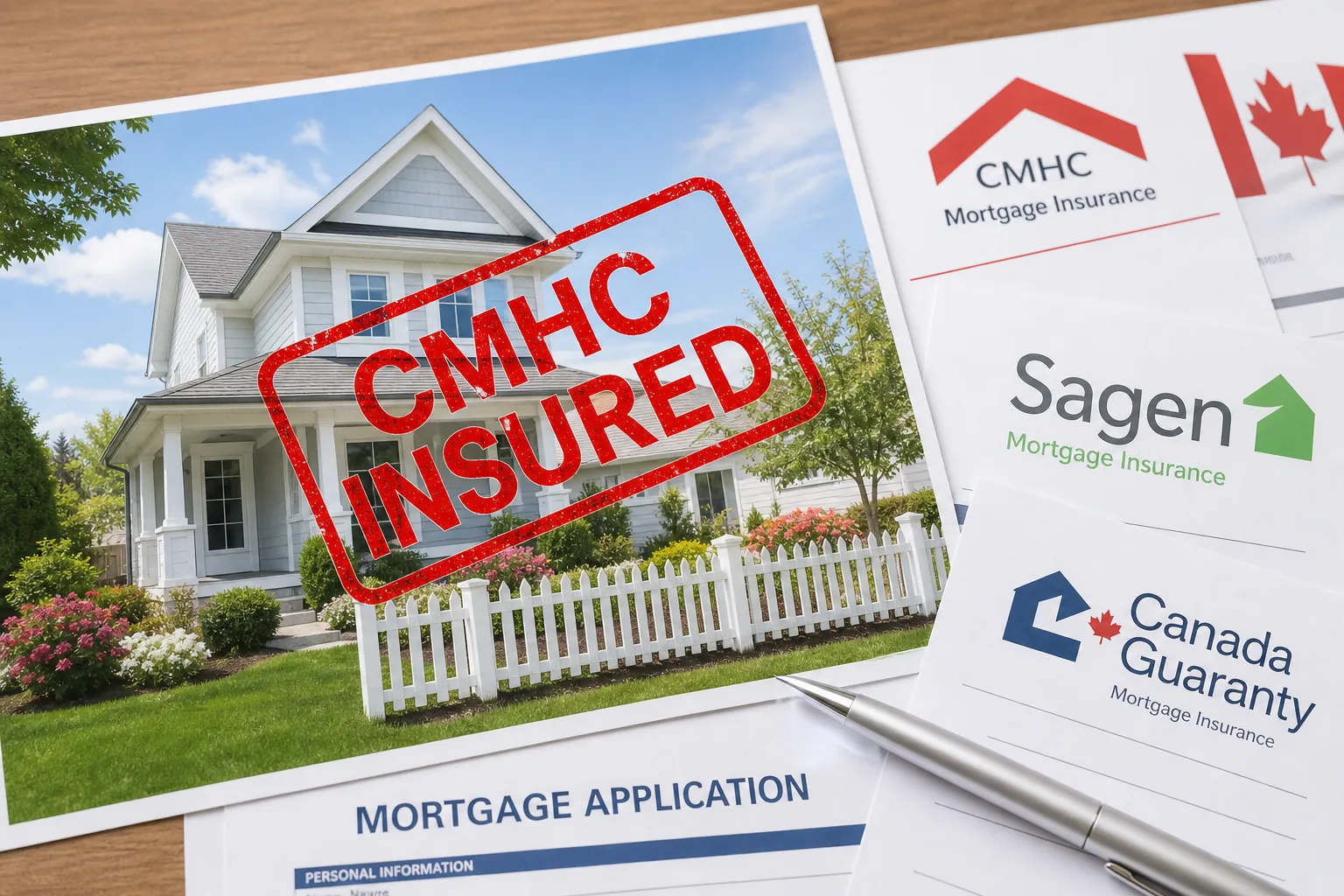
Mortgage loan insurance in Canada is available through CMHC and private insurers including Sagen and Canada Guaranty. The lender normally chooses the insurer based on its relationships and the file. A borrower cannot assume that approval by one lender or insurer guarantees approval elsewhere.
Product rules can differ by property, occupancy, amortization, income documentation, and loan purpose. Compare the mortgage commitment, not a general description of the insurer.
How premiums are calculated
The premium is a percentage of the insured loan amount. CMHC's published homeowner schedule currently ranges from 0.60% at lower loan-to-value ratios to 4.00% for a standard loan above 90% and up to 95% loan-to-value; some programs or amortizations can add a surcharge. FCAC describes the broader premium range as 0.6% to 4.5%.
Use the insurer's current table and the lender's final documents for the exact amount. Do not rely on a worked example from a different down payment, amortization, or program.
How the premium and Ontario sales tax are paid
The borrower can generally add the mortgage-insurance premium to the mortgage principal, which means interest is paid on it over time. In Ontario, provincial sales tax applies to the premium and cannot be added to the loan, so it must be included in closing cash.
The statement of adjustments and lender instructions should show how the premium and tax are handled. Confirm the cash requirement before waiving financing conditions.
Insurance does not guarantee approval
The borrower must satisfy both the lender and insurer. Income, credit, debt-service ratios, down payment, source of funds, property condition, appraisal, and occupancy can all affect the decision. The minimum down payment is therefore a legal or program threshold, not a promise that every file qualifies at that amount.
A document-backed pre-approval should identify the assumptions and any insurer review still outstanding.
Portability and premium credits
Mortgage insurance is not normally refunded simply because the home is sold or the mortgage is paid out. However, CMHC publishes a portability feature that may reduce or eliminate part of the premium on a subsequent insured purchase, depending on timing and the new loan. Energy-efficiency programs may also offer a partial premium refund when their criteria are met.
Ask the lender or insurer about portability before the existing mortgage is discharged. The available credit and deadlines are product-specific.
A premium calculation example
For illustration, a $700,000 purchase with 10% down has a $630,000 base mortgage. Under CMHC's current standard homeowner schedule, a 90% loan-to-value mortgage uses a 3.10% premium, or $19,530. If the premium is added to the mortgage, the insured principal becomes $649,530. Ontario's 8% sales tax on the premium would be $1,562.40 and is normally paid at closing.
The lender's final calculation controls. A different down payment, amortization, program, or insurer can change the result.
Sources and reference points
MD
About the author
Licensed Mortgage BrokerMortgagePal Inc. · Brokerage #12685MortgagePal
Mackenzie Docksteader is an electrician and Mortgage Broker based in Bracebridge, serving Gravenhurst, Huntsville, Muskoka and Ontario. He specializes in self-employed mortgages, with firsthand experience in trades and construction businesses, as well as cottage properties, alternative lending, and complex financing files. Guides provide general information; lender policies and regulations can change.
Sources, corrections and brokerage details